















Data Center Construction Safety: What Makes It Different From Standard Commercial Builds
U.S. data center construction spending rose to a seasonally adjusted annual rate above $75 billion in July 2026, according to the Census Bureau. This is nearly 60% higher than a year earlier as AI companies and cloud providers race to expand computing infrastructure. Global data center capacity is set to nearly double by 2030, according to JLL’s 2026 Global Data Center Outlook, requiring up to $3 trillion in investment over the next five years.
This buildout is one of the defining infrastructure moments of this decade. It is also creating construction conditions that even the strongest and best-resourced safety programs cannot manage.
Data center construction looks like commercial construction on the surface: structural steel, concrete, mechanical, electrical, and plumbing systems, with large, complex job sites and multiple contractors working simultaneously. But the risk profile is different, creating an environment where standard approaches are inadequate.
This article names those differences precisely for EHS leaders, project directors, and commissioning managers who understand commercial construction safety and are scaling into data centers for the first time.
Energized Electrical Hazards
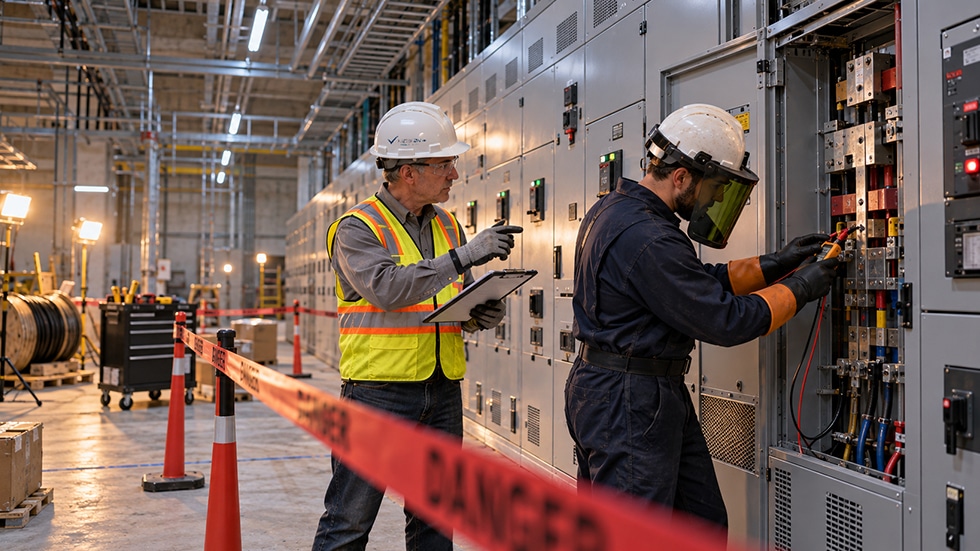
Electrical systems in hyperscale data centers differ significantly from those in standard commercial projects. High-voltage switchgear, large UPS systems, generators supporting full facility loads, and medium-voltage distribution systems create hazardous energy exposures that exceed those found in typical commercial MEP environments.
Phased energization is the primary complicating factor. In standard commercial buildings, electrical systems remain de-energized during construction and are energized near completion. In data centers, crews progressively energize sections of the electrical system in phases while construction continues nearby. Non-electrical workers may be exposed to energized systems they do not recognize as hazardous.
This environment requires safety measures that exceed standard OSHA construction electrical practices:
- Arc flash hazard analysis must be conducted at each energization milestone, not only at project completion. As new sections are energized, arc flash boundaries and incident energy levels change. PPE assignments based on pre-energization studies may become inaccurate.
- NFPA 70E compliance, the U.S. standard for safe electrical work practices, requires energized work permits, arc flash risk assessments, and PPE selection based on incident energy analysis for any work on or near energized equipment. In data centers, where multiple trades may work near energized systems, safety professionals must be fluent in the requirements of NFPA 70E.
- Lockout/tagout procedures in data centers must address partial energization, where one section is de-energized while adjacent sections remain live. Standard LOTO programs for fully de-energized systems may not cover these hazards. Procedures should be developed at the equipment level to reflect actual isolation points and energy sources.
Commissioning Risk: Where Construction and Operations Collide
In most commercial projects, commissioning is a distinct phase after construction is complete. In data centers, this process begins earlier and overlaps with construction.
Data center commissioning follows a Level 1-5 progression, beginning with component inspections and pre-functional testing and advancing to integrated systems testing (IST) at full operational load. This process starts before construction is finished and often overlaps with ongoing work. Multiple trades and commissioning teams operate in close proximity, conducting live tests in areas where construction is still underway.
Risk is highest during IST, which involves operating the facility under load bank conditions, testing generator and UPS failover sequences, and simulating failure modes to verify system resilience. These tests place significant stress on the electrical infrastructure, intentionally creating the most hazardous electrical conditions. Construction often continues in adjacent areas during this phase.
Managing this overlap safely requires coordination beyond standard construction safety programs. Safety professionals must be fully integrated into commissioning workflows, with a clear understanding of the testing schedule, the systems involved, and the hazard zones created by each test, rather than simply knowing commissioning is happening nearby.
The Uptime Pressure Problem
Hyperscale data center clients are bound by Tier III and Tier IV uptime commitments, which place significant pressure on construction schedules. Delays result in lost revenue for the client and contract penalties for developers and general contractors. This pressure extends beyond the executive level, influencing decision-making on the job site.
The primary safety risk is not that schedule pressure directly causes incidents, but that it undermines standard safety checks. Pre-task planning may be shortened, work may begin before energy isolation is confirmed, and crews may forgo necessary questions due to time constraints.
A unique challenge in hyperscale data centers is the concurrent handover model, where parts of a facility become operational for tenants while construction continues elsewhere. This results in an occupied construction environment, requiring workers to operate alongside live systems and active tenant operations. Such conditions demand coordination and communication beyond standard construction site management.
Safety programs in this environment must remain effective despite schedule pressure. Pre-task planning should be practical and efficient, and communication protocols must support fast-paced work. Safety leadership also requires strong organizational backing to intervene when schedule demands threaten safe practices.
The Skills Gap on Data Center Job Sites
Data center construction is growing faster than the supply of workers with mission-critical experience. Skilled electrical and controls trades who also have data center-specific knowledge of high-voltage systems, BMS/EPMS integration, and commissioning are in short supply. Projects are expanding quickly, introducing traveling labor and new subcontractors at a pace that exceeds the ability to properly vet and onboard them.
According to ConstructConnect, as of February 2026, 76 data center projects valued at over $88 billion were in preconstruction, with start dates within six months. Meeting this demand will require a larger workforce with the necessary expertise.
Workforce turnover and rapid expansion increase safety risks. New workers face a higher risk of injury. In data centers, hazards such as energized systems, specialized equipment, and complex coordination make unfamiliarity with the environment more dangerous than in typical commercial construction.
Site-specific orientation programs should address the facility’s actual hazards, including energization status, restricted zones, commissioning activities, and the electrical systems present. Competency checks must verify not only general trade credentials but also data center-specific experience. On-site safety professionals should offer real-time coaching to technically qualified crews who may be new to this environment.
What It Takes to Do Safety Right in Mission-Critical Environments
The unique demands of data center construction require safety professionals to possess specialized capabilities beyond those needed for standard commercial projects.
NFPA 70E fluency
While general OSHA construction knowledge is required, it is not sufficient in environments with ongoing energized electrical work. Safety professionals must understand arc flash risk assessment, select PPE categories based on incident energy analysis, and manage energized work permit requirements. They must also apply this knowledge in real time as the site’s energization status evolves.
Integration with commissioning workflows
Those who understand the commissioning schedule, know which systems are being tested, and coordinate safety requirements with the commissioning team are significantly more effective. This effectiveness requires familiarity with the Level 1-5 commissioning progression, the associated testing activities, and the hazard zones created at each stage.
Dynamic hazard assessment systems
The risk profile of a data center construction site evolves as construction progresses, systems are energized, and commissioning phases advance. An initial hazard assessment does not reflect site conditions months later. Safety programs must include regular, systematic hazard reassessments aligned with construction milestones and commissioning events.
Comprehensive subcontractor safety oversight
Data center projects involve multiple general contractors and large groups of subcontractors, each with varying safety programs, training standards, and experience in mission-critical environments. Consistent safety standards require dedicated oversight, including prequalification, site-specific orientation, daily field observation, and documentation for all employers on site.
HazTek’s data center safety professionals have backgrounds in Mission Critical, Electrical, and Project Management disciplines. Our team has direct experience with both new builds and operational data center facilities. We offer a customized consultant onboarding program that aligns with client processes from day one. Our team can mobilize quickly and scale resources as project demands change, ensuring safety coverage keeps pace with construction.
To learn more about HazTek’s safety services or to discuss how we can support your next mission-critical project, please contact our team.
Frequently Asked Questions
What is Integrated Systems Testing (IST) in data center construction?
Integrated Systems Testing is the final and most complex phase of data center commissioning. During IST, mechanical, electrical, and control systems are tested together under simulated operational conditions. This process includes running the facility at full load with load banks, testing generator and UPS failover sequences, and simulating failure modes to confirm backup systems respond correctly. Since IST intentionally stresses the electrical infrastructure while construction may still be underway nearby, it is one of the highest-risk phases of a data center build from a safety perspective.
What voltage systems are used in data centers, and why does that matter for construction safety?
Data centers operate with electrical systems at much higher voltages than standard commercial buildings. Medium-voltage systems, typically from 4kV to 35kV, deliver power from utilities to on-site transformers and switchgear. Low-voltage systems, usually at 480V or 208V, distribute power to UPS systems, PDUs, and equipment. High-voltage systems and large-scale UPS and generator installations create arc flash hazards that exceed the capabilities of most commercial construction safety programs. Arc flash incident energy at data center switchgear can require PPE rated at 40 cal/cm² or higher, which is well above standard construction requirements.
What is the difference between Tier III and Tier IV data centers from a construction safety perspective?
Tier III and Tier IV classifications, as defined by the Uptime Institute, indicate a facility’s level of redundancy and fault tolerance. Tier III facilities allow for concurrent maintainability, so any component can be removed or replaced without shutting down operations. Tier IV facilities are fully fault-tolerant and can sustain any single failure without affecting operations. Higher-tier facilities require more complex and redundant electrical and mechanical systems, resulting in more energized systems during construction, more complex lockout/tagout requirements, and increased exposure for crews working near live infrastructure. Commissioning for Tier IV facilities is also more complex, extending the overlap between construction and commissioning activities.
References:
https://economy.ac/news/2026/09/202609295545
https://www.Referencesus/newsroom/global-data-center-sector-to-nearly-double-to-200gw-amid-ai-infrastructure-boom
https://news.constructconnect.com/february-2026-data-center-report-after-record-growth-the-outlook-for-the-year-ahead