





Why Life Sciences Construction Demands a Different Safety Approach
Pharmaceutical, biotechnology, and medical device facilities are built under conditions most construction safety programs were not designed to handle. The work moves fast, the regulatory environment is exacting, and the hazards require expertise beyond general construction experience.
For safety managers, project managers, and EHS leaders, the challenge is managing risk in a highly regulated, high-precision environment where a safety gap and a compliance gap can be the same problem.
This article examines what makes life sciences construction uniquely demanding from a safety standpoint, and what effective safety management looks like in practice across these facility builds.
What Makes Life Sciences Construction Different
On the surface, a pharmaceutical construction project may look like any other large commercial build—steel erection, mechanical installation, electrical work, work at heights. But the context changes everything.
Clean facility construction
Workers must build environments that meet exact contamination control standards. The construction process introduces risks absent in standard builds: specialized processing equipment must be installed without compromising facility integrity, proprietary manufacturing systems require careful handling, and construction sequences are often constrained by the facility’s operational requirements.
Regulatory complexity
Pharmaceutical and biotech construction is governed not just by OSHA standards and general construction regulations, but by FDA guidance documents, Current Good Manufacturing Practices (CGMP), Good Clinical Practices (GCP), and Good Laboratory Practices (GLP).
These frameworks set expectations that shape how construction is planned, executed, and documented. A safety professional who lacks this context operates without critical information.
Contractor and owner policy alignment
Owners of pharmaceutical facilities often have site-specific safety and quality requirements beyond standard contractor programs. When these requirements aren’t clearly communicated, assessed, and enforced before work begins, a gap forms between owner expectations and field reality. Closing that gap requires proactive assessment, not reactive enforcement.
The Hazard Profile: What Safety Managers Need to Know
Life sciences construction combines several of the most serious industrial hazards into one project environment. Understanding this profile is the starting point for effective safety management.
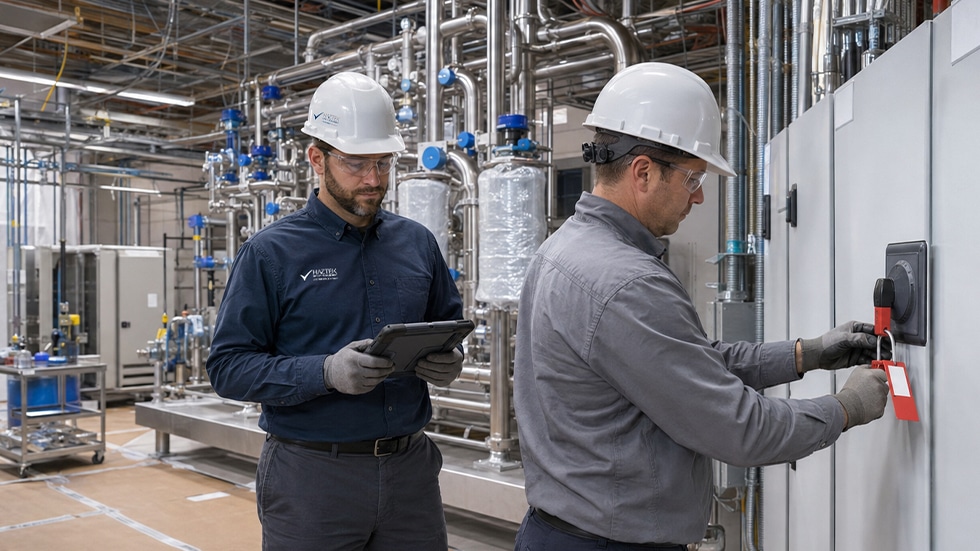
Control of hazardous energy (LOTO)
Pharmaceutical and biotech facilities are highly energized environments. Complex generator installations, backup battery power systems, and specialized processing equipment create hazardous energy sources that must be controlled throughout construction.
LOTO procedures often need to be developed at the equipment level, reflecting specific energy sources and isolation points for systems unlike those in standard LOTO programs.
Electrical safety
Work in proximity to energized distribution systems, medium-voltage equipment, and specialized facility power infrastructure demands professionals trained to NFPA 70E standards who understand the arc flash and shock hazards specific to the equipment configurations they are working around.
Working at heights
In life sciences environments, this involves complications general fall protection programs may not address. Restricted access areas, cleanroom protocols, and specialized equipment can limit standard fall protection use and require engineered solutions tailored to the environment.
Hot work, lifting, and material handling
These hazards carry elevated risk in facilities with constrained environments, specialized equipment, and narrow margins for error. Pre-task planning and job hazard analysis must account for site-specific conditions that change as construction progresses.
Biological, radiological, and laboratory safety considerations
These are relevant on certain life sciences projects—particularly R&D facilities, pilot plants, and manufacturing environments where hazardous substances may be present or where the facility is transitioning between construction and operational phases.
CGMP Awareness: Why Regulatory Knowledge Matters in the Field
One of the most significant differentiators between a safety professional with life sciences experience and one without is familiarity with CGMP requirements and how they interact with construction activity.
CGMP govern the design, construction, and operation of pharmaceutical manufacturing facilities. During construction, this means documentation requirements, material traceability standards, and quality control protocols that affect how safety programs are implemented and recorded. A safety manager who understands that a decontamination procedure or material substitution has both operational and regulatory implications is in a fundamentally different position to support the project.
The same applies to GCP and GLP frameworks for clinical and laboratory environments. They shape how work is planned, how incidents are documented, and how changes to scope or procedure are managed. Safety professionals working in life sciences construction need to understand where their safety program touches these frameworks and how to operate within that context without creating compliance gaps.
Contractor-Owner Policy Alignment: Closing the Gap Before Work Begins
One of the most preventable sources of safety failure on pharmaceutical and biotech construction projects is the gap between contractor safety programs and owner site requirements. These gaps occur because contractor programs are designed for general construction, while owner requirements target a regulated facility environment. The two do not always speak the same language.
Effective alignment starts before mobilization. Gap assessments comparing contractor safety programs to owner requirements identify differences, which gaps create real risk, and what must change before workers arrive on site. This process is especially important on multi-contractor projects, where each subcontractor may bring a different safety program and varying familiarity with pharmaceutical facility requirements.
Ongoing oversight is equally important. Contractor policies aligned before work begins can drift as the project progresses, personnel change, and site conditions evolve. Safety professionals embedded on the project who understand both contractor programs and owner expectations are best positioned to maintain alignment throughout the project.
What Effective Life Sciences Safety Management Looks Like in Practice
Pharmaceutical and biotech construction demands safety professionals who operate across technical, regulatory, and organizational dimensions simultaneously. In practice, that means:
- Full-time, embedded safety professionals with life sciences backgrounds who understand the daily work plans, equipment configurations, and site-specific hazards they are managing.
- Site-specific safety planning reflecting actual facility conditions, including clean room protocols, hazardous energy control procedures for specific equipment, and fall protection solutions for restricted environments.
- Dynamic safety planning that adapts as the project moves from ground-up construction through mechanical installation, commissioning, and validation. A safety plan for one phase may not suit the next.
- Industrial hygiene support for projects involving noise exposure, air contaminant monitoring, and potential chemical or biological exposures during construction and transition to operations.
- Owner representative services for pharmaceutical companies and facility owners who need independent safety oversight to ensure contractor performance meets their standards throughout the project.
Choosing the Right Safety Partner for Life Sciences Construction
Not every safety organization is equipped for life sciences construction. The combination of technical complexity, regulatory awareness, and sector-specific experience required is genuinely difficult to replicate without deep involvement in the industry.
When evaluating a safety partner for a pharmaceutical or biotech project:
- Look for professionals with direct backgrounds in the sector, not just general construction experience applied to a specialized setting.
- Verify that they understand CGMP, GCP, and GLP requirements and can speak to how those frameworks affect safety program development and documentation.
- Confirm they have experience supporting the full range of project phases, from new builds through commissioning and validation
- Confirm they can mobilize quickly and scale resources as the project demands.
HazTek has supported pharmaceutical, biotechnology, and medical device construction projects for over 26 years, working with Fortune 500 organizations, mid-size companies, and startups across the U.S. and internationally. Our safety professionals bring direct life sciences backgrounds and a working knowledge of the regulatory environment that governs these facilities, giving clients a partner who understands the work from the inside.
If your organization has an upcoming life sciences construction project, contact us to learn how our experienced team can support your safety program from ground-up construction through commissioning and beyond.